
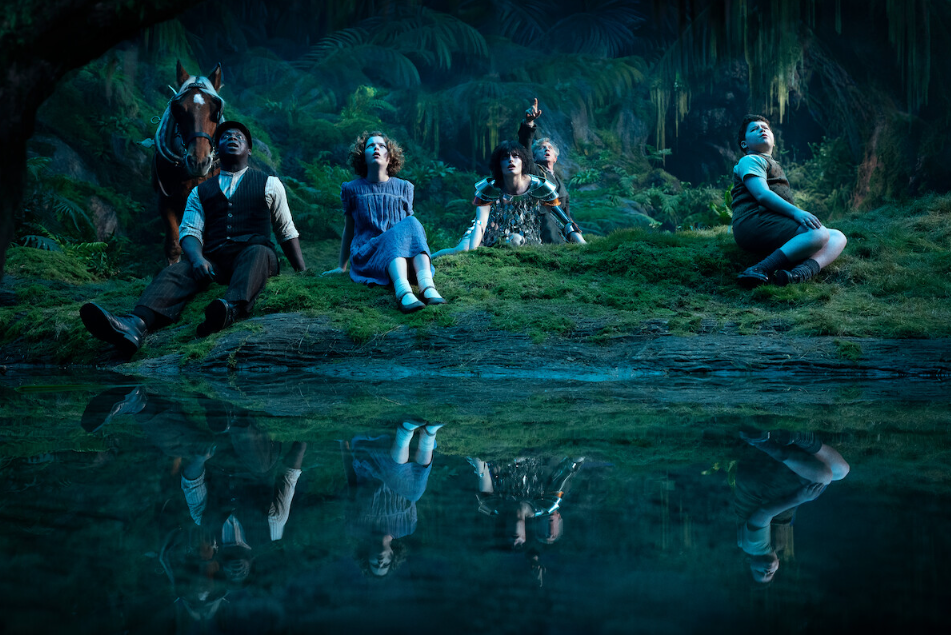
It was predictable. Christians are once again getting themselves into knots over a movie they haven’t yet seen. Here’s the trailer, which has released a fresh wave of Christians getting uppity. Most, but not all, of it is a bit boneheaded.
This post contains affiliate links. As an Amazon Associate I earn from qualifying purchases, at no extra cost to you.
It’s for children
The first thing to note is that all the people getting very upset about this are adults. The next thing to note is that The Magician’s Nephew was a book written for children. One useful test would be to show the trailer to a ten-year-old and ask them whether they would like to watch the movie when it comes out. I suspect you’ll get a different response.
Alan Jacobs in his excellent book on Lewis says,
In most children but in relatively few adults, at least in our time, we may see this willingness to be delighted to the point of self-abandonment. This free and full gift of oneself to a story is what produces the state of enchantment. But why do we lose the desire—or if not the desire, the ability—to give ourselves in this way?
The Narnian: The Life and Imagination of C.S. Lewis (loc 326)
All the huffing and puffing in the Christian twittersphere is evidence of an inability to be delighted and a boring refusal to simply give yourself to a story. There’s no enchanting some folks.
And enchantment is one of Gerwig’s main goals: “I wanted it to be big and transporting,” she says in her interview with Empire magazine. And this is the right idea when you’re talking about a book that is a creation story. The birth of a world needs to be magical. As no one knows what that looked like or what soundtrack to put to it – there’s a certain freedom here for artistic expression. It’s also a big ask because not even a director of Gerwig’s talents can capture creation. But good for her if she has a real good go at it.
We should heed Jacobs’ words on what is central to understanding Lewis:
Surely Lewis himself would have said that when we can no longer be “wide open to the glory”—risking whatever immaturity thereby—we have not lost just our childlikeness but something near the core of our humanity. Those who will never be fooled can never be delighted, because without self-forgetfulness there can be no delight, and this is a great and a grievous loss.
ibid. loc 349
Don’t fret the time-shift

In this version of The Magician’s Nephew Gerwig has shifted the time from 1900 London to the post-war 1950s. This has upset some people. It shouldn’t.
This is a story about something that happened long ago when your grandfather was a child.
That’s the very first sentence of The Magician’s Nephew.
David McKenna, who plays Digory (pictured above on set with Gerwig), brought his grandparents to filming one day, “They said it was literally like walking back into their childhood.”
What Gerwig has done, and this might offend some people, is take Lewis quite literally at his word.
Of course what this means is that when it comes to The Lion, the Witch and the Wardrobe and the rest of the Narnia books they are going to need a time shift too. If Gerwig, or whoever follows her, keeps the shift that will mean a setting of the early 2000s. Will that lose the spirit of those books? After all one of the setups to LWW is the Pevensie children have been evacuated from London because of the blitz. So how could that work 50 years later where there was no evacuation?
Two things are at work here. First of all Lewis published all the Narnia books in the 1950s. The Magician’s Nephew was published sixth and that came out in 1955. The first children reading his books had likely lived through the war, the blitz wasn’t just living memory but their memory.
However, and this is key, the Narnia books aren’t about post-war Britain. They’re about Narnia. The evacuation to a big house to encounter a magical wardrobe is a plot device Lewis invented to get Lucy and co to Narnia. There are plenty of options 50 years later to get 4 kids to a big house in the country.
The turn of the millennium, thanks in part again to Christians losing their minds, witnessed the collective fuss about Y2K, or there’s 9/11 and the wars in Iraq and Afghanistan (with evangelical Christians again thinking it was the end of the world).
But perhaps more likely is a slightly longer shift to today. What world shaping event have the ten-year-olds of today lived through that forced children to spend a long time in a house or conceivably get stuck in a house in the country? Oh gosh, who knows, maybe a global pandemic?
How magical is Jadis?

At 1:47 in the trailer we see Jadis, who becomes the White Witch, blast a car and shatter the windows of a pub with her wand. This has upset some people. Some are upset because the pub that gets collateral damage is The Eagle & Child, a nice nod to the pub that Lewis, Tolkien and the Inklings used to frequent in, and note this, Oxford. If Gerwig is allowed to move the pub to London, and none of the Narnia books are set in Oxford, then she’s allowed to smash its windows. That probably doesn’t mean anything.
But more to the point is a debate over whether in our world Jadis has any powers or not. In chapter 7 of The Magician’s Nephew, Jadis tries to obliterate Digory’s Aunt Letty.
Fire flashed from her eyes: she flung out her arm with the same gesture and the same horrible-sounding words that had lately turned the palace-gates of Charn to dust. But nothing happened…
It must have been a terrible moment for the Witch when she suddenly realized that her power of turning people into dust, which had been quite real in her own world, was not going to work in ours.
And that, for some, is that.
Except Lewis hasn’t entirely neutered Jadis. She is, for one, extremely tall and superhumanly strong, “She could break an iron bar as if it were a stick of barley-sugar.”
I think Gerwig could have conveyed an evil superhuman without her brandishing her wand, and that would have been more accurate to the book. Then again nothing says Witch more than a wand and I doubt in the long run this detail alters anything in her telling of the story. Jadis’ lack of power in our world is almost entirely incidental to the place where her power and magic do work: Narnia. Gerwig is giving a nod to the awful power Jadis wields with her wand that turns people not to dust but to stone.
Translan?

But all of the above is small beer compared to the near-hysteria levels shown by Christians upon learning that Aslan the Lion is to be voiced by Meryl Streep. There are many, many, otherwise sensible Christians losing their minds over this. The essence of it is neatly put by Liel Leibovitz:
A woman can’t play Aslan because Aslan is Jesus, and Jesus, the son of God, is male. To alter that fact is to make him precisely what he is not: an allegory that may be repurposed and redesigned at will.
And this is where I remind everyone we’re talking about a fictional lion. Aslan is a fictional picture of Christ, not Christ himself. Aslan does not exist. Jesus did and does. That’s a significant difference right there and some Christians seem to be a bit confused on this point.
But still doubts persist, as Annie Crawford says,
A world ruled by Aslana is a world quite different in character from Narnia. A story in which the children bow before the Lioness is a story quite different in character than the Chronicles of Narnia.
Aslan as pictured here is definitely not a lioness. It’s the mane that gives it away. So Gerwig has not made Aslan female. What we have then is the body of a male lion and the voice of the female Meryl Streep.
So Translan then? Except if you really want to push that then it doesn’t really work in favour of a transgendering of Aslan. That framework says you can change the body to match the inner soul that is who you really are. The body is malleable but the soul, if you like, is not. Gerwig has clearly refused to change Aslan’s body. But has she, by casting Streep, changed Aslan’s soul? Has she made the outwardly male Aslan inwardly female simply by casting Streep to voice the great lion?
That will depend entirely on what Aslan’s voice ultimately ends up sounding like and I suspect we won’t hear Aslan at all in the trailers. I’m hoping that no one, not even Gerwig, wants Prada-Aslan.
Gerwig says, “I wanted someone who was profound but not pretentious, who had gravitas but not morose self-seriousness. Someone who could communicate depth and pathos as well as joy and delight. I wanted someone who was older than 70, so there was a wisdom of experience, but who also had the capacity of fresh wonder, like a child. And also to be one of the greatest actors to ever do it. That list is not a long one.”
That’s not a slam dunk casting choice for Streep because Lewis specifically says that Aslan’s voice is deep and Streep’s is not usually that. Who knows what a male lion’s voice would sound like if it could talk? Because, in case you hadn’t noticed, lions can’t usually do that. So if Streep can convey gravitas, age, delight, wisdom, power then could it still be Aslan? I’m open to the possibility. After all what Gerwig is wanting Streep to do is, *checks notes*, act. And Streep undoubtedly can do that. Can she drop her voice an octave and then sprinkle it with a little bit of movie magic to give it some growl? Maybe she can. But then why cast Streep at all? Gerwig knows Aslan needs a lower register but she wants Aslan to have pathos, joy, delight, wisdom, gravitas and a little levity and she believes she hears that in Streep’s voice. I say, at the very least, hold your fire until you hear it.
It is, without a doubt, the greatest risk Gerwig has taken. She is smart enough to know that to get this wrong, to get Aslan wrong would ruin the movie for so many fans. And upsetting a huge part of the Narnia fanbase is not smart. Although I assume the marketers at Netflix also know that stirring up some controversy with evangelical Narnia fans will generate attention like almost nothing else. Definitely can’t rule out that reasoning.
Gerwig seems to have a genuine love for the Narnia stories. Whether or not she understands them in the same way as many Christians do, we will have to wait and see.
Leave a Reply